


 Menu
Menu

Leadership is often associated with titles, positions or responsibility for others.
But there is one leadership role every one of us already holds.
You are the CEO of your life.
The real question is whether you are intentionally leading it or simply responding to whatever comes your way.
One of the most effective tools for stepping into this role is the Wheel of Life. It provides a simple way to assess how balanced the key areas of your life are today.
Because sustainable success rarely comes from one area of life alone.
Life by Design, Not by Default
The reality is simple. If you do not design your life, someone else will. Before long, you may find yourself spending much of it helping others achieve their goals instead of your own.
That is why I encourage people to create a life by design, not by default.
Careers evolve, opportunities appear, responsibilities grow, and years pass quickly. Without intention it is easy to drift into responding to the priorities of others while quietly postponing our own.
Living life by design begins with recognising that leadership is about taking responsibility for the direction of your own life and stepping into the role of CEO of your life.
Every day we make decisions about how we spend our time, energy and attention.
Over time, those decisions shape the life we are building.
The first step is awareness. Ask yourself:
- What truly matters to me right now?
- Am I allocating my time and energy accordingly?
- Am I building the life I want, or simply maintaining the one I have?
The Wheel of Life helps evaluate the key areas of your life and supports more intentional decisions about the future.
What Is the Wheel of Life?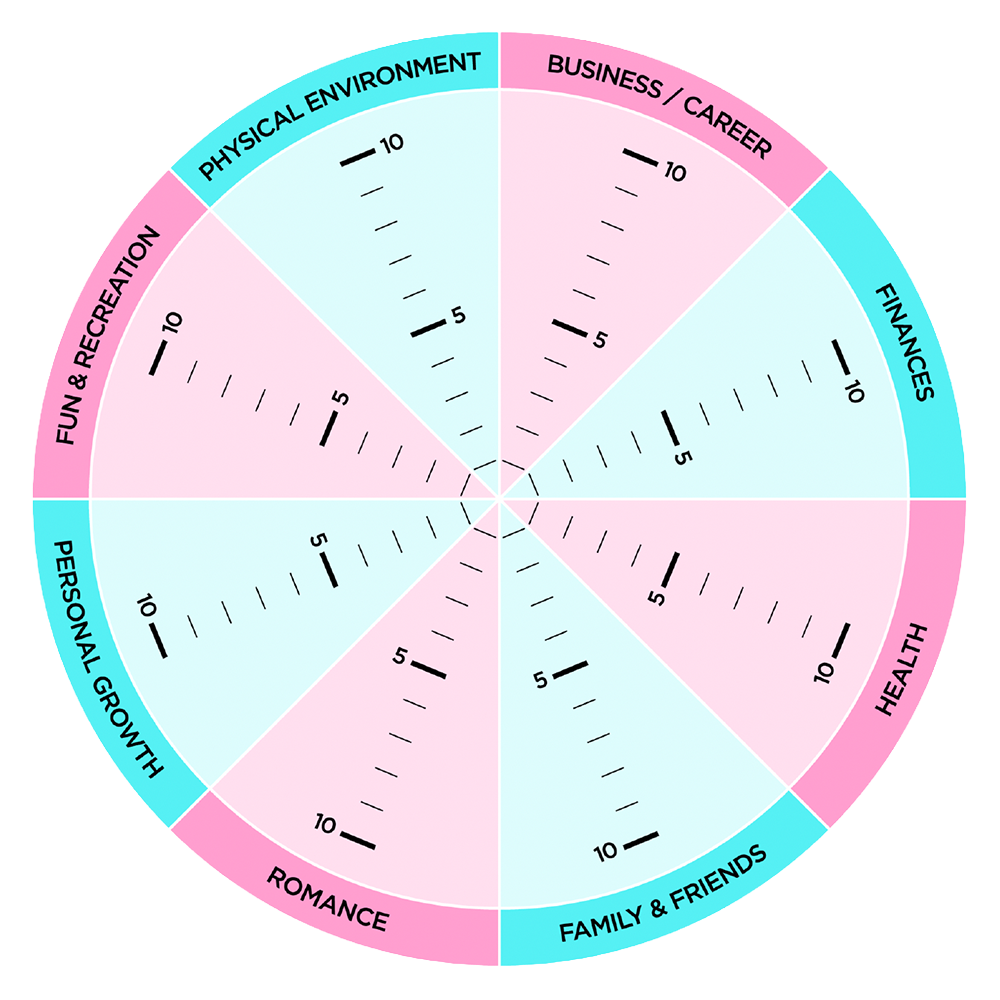
The Wheel of Life is a simple coaching framework used by leaders and practitioners to assess satisfaction across important areas of life.
Typical life domains include:
- Business or Career
- Finances
- Health and Energy
- Family and Friends
- Romance and Relationships
- Personal Growth
- Fun and Recreation
- Physical Environment
Each area is rated from 1 to 10, where 1 represents very low satisfaction and 10 represents a high level of fulfilment.
When the scores are connected visually, they form a wheel.
When areas are balanced, the wheel rolls smoothly. When they are not, the wheel becomes uneven and difficult to move forward. The metaphor is simple but powerful.
Many people are trying to drive their life forward on a very bumpy wheel.
Wellbeing Is Multi-Dimensional
Research shows wellbeing is influenced by multiple areas of life.
Positive psychology pioneer Martin Seligman introduced the PERMA model of wellbeing, which identifies five contributors to human flourishing: positive emotion, engagement, relationships, meaning and accomplishment¹.
Notice that achievement, often associated with career success, is only one part of the equation.
Similarly, the Harvard Study of Adult Development, one of the longest running studies on happiness, led by Robert Waldinger, found that strong relationships are the strongest predictor of long-term happiness and health, more than wealth or status².
Financial security contributes to wellbeing, but it is rarely sufficient on its own.
Balance across several life domains supports long-term fulfilment.
Happiness Often Comes Before Success
Many people assume success leads to happiness. Research suggests the opposite may often be true.
Studies popularised by Shawn Achor show that when people experience positive emotional states, productivity, creativity and resilience increase³.
In other words, happiness can be a precursor to success, not just the result of it.
Yet many people operate with the assumption:
“Once I achieve the next milestone, then I will be happy.”
The Wheel of Life challenges that thinking by encouraging us to strengthen the areas that contribute to wellbeing now, not someday.
What the Wheel Often Reveals
When people complete the Wheel of Life exercise, three common responses emerge.
1. High satisfaction (scores mostly 6-10)
If your scores are high across many areas, appreciate the moment.
Life will not always feel this balanced. Every life moves through stages and seasons of growth, challenge and change. When things are going well, take time to enjoy the season you are in.
2. Lower satisfaction (scores mostly below 5)
This can feel confronting.
But remember the old saying: “This too shall pass.”
Periods of challenge, stress or imbalance happen to everyone. The goal is not to fix everything overnight, but to take one small step toward improvement⁴.
3. A mixed or uneven wheel
This is the most common outcome.
Some areas of life may be thriving while others are being neglected. Career may be strong, but health is low. Finances may be solid, but relationships need attention.
The Wheel of Life highlights where small adjustments can create the greatest improvement in overall wellbeing.
Often lifting just one area by a single point can significantly improve how balanced life feels.
Choosing Happiness Intentionally
It is unrealistic to expect to feel happy all the time. Life naturally has its ups and downs.
Happiness is not a permanent emotional state. It is a daily intention.
We experience it more often when we consciously choose:
- Gratitude
- Perspective
- Progress over perfection
Small mindset shifts can significantly influence how we experience our lives.
Wheel of Life Exercise
Take 5 to 10 minutes to complete the downloadable Wheel of Life exercise.
- Review the eight segments representing key areas of your life.
- Score each area from 1 to 10 based on your current level of satisfaction.
- Connect the scores and observe the shape of your wheel. How smooth or bumpy is it?
Then ask yourself:
- Which area needs the most attention right now?
- What is one small action within my control that could lift it by just one point?
- What are the top three areas you would like to focus on over the next 90 days?
Consider sharing this exercise with your loved ones or team at work. You may be surprised by how much you learn about each other and how powerful the conversation can be.
The Power of 1% Better (1.01)365 = 37.78 pa
Meaningful change rarely comes from dramatic transformation. More often, it comes from small improvements compounded over time. Getting just 1% better each day results in being almost 37 times better over the course of a year⁵. Imagine applying that to your:
- Health
- Career
- Relationships
- Personal growth
What would you like to be 37 times better at by this time next year? Perhaps it is a combination of them all.
A Final Thought
Whether you are redesigning your career, building a stronger business, improving your wellbeing, creating more balance, or simply reconnecting with yourself, the first step is awareness, and the Wheel of Life is a powerful place to start.
Remember, you are the CEO of your life. Design it intentionally.
Because when your life wheel runs smoothly, everything moves forward more effectively — your wellbeing, your relationships, your career and your future.
And sometimes the most powerful change begins with something very small. Just 1% better.
In next month’s Money & Life article, we explore Values – the internal compass that shapes our decisions, priorities, and ultimately the direction of our lives.
Get in touch with Cate at Inspiration Cafe or Find a Planner near you!
Sources
- Seligman, M. (2011). Flourish: A Visionary New Understanding of Happiness and Wellbeing.
- Waldinger, R. & Schulz, M. (2023). The Good Life: Lessons from the World’s Longest Scientific Study of Happiness.
- Achor, S. (2010). The Happiness Advantage.
- Fogg, B. (2019). Tiny Habits: The Small Changes That Change Everything.
- Clear, J. (2018). Atomic Habits: An Easy and Proven Way to Build Good Habits and Break Bad Ones.
The Money & Life website is operated by the Financial Advice Association Australia (FAAA). The views expressed in this article are those of the author and not those of the FAAA. The FAAA does not endorse or otherwise assume responsibility for any financial product advice which may be contained in the article. Nor does it endorse or assume responsibility for the information.